
New method for American Foulbrood disease control
What is american foulbrood disease?
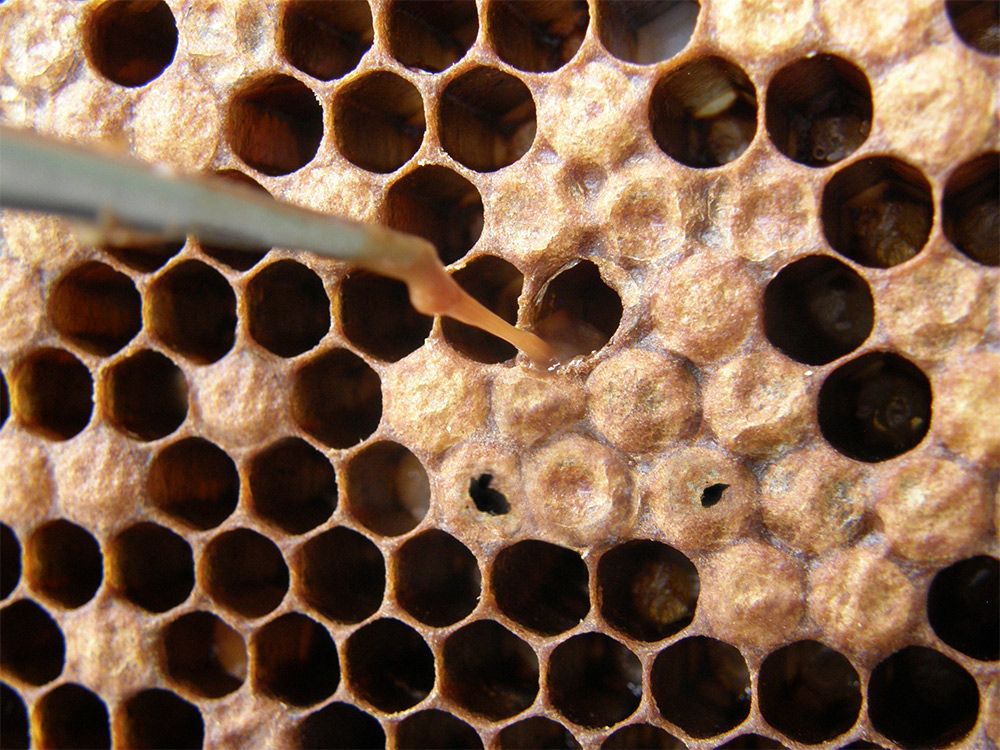
The american foulbrood [AFB] disease is an endemic and epidemic bacterial disease caused by the Paenibacillus larvae. Paenibacillus larvae can only infect the honeybee larvae when they are one or two days old. There are no antibiotics that can kill the spores of the Paenibacillus larvae.
The Paenibacillus larvae must be treated in the worker jelly when the honeybee larvae are one or two days old and have not been infected. The most damaging effects of AFB disease are seen in the early spring and the end of the season because of the large quantities of worker jelly created during these times.
More information
For seventeen years (fourteen years in Iran and three years in Canada) Caspian Apiaries has been eliminating american foulbrood disease by using Caspian Solution, a blend of royal jelly, pheromone, and other natural ingredients. This solution increases the production of worker jelly, which promotes the transfer of the Paenibacillus larvae from the spore to the bacteria and creates the opportunity to destroy the bacteria with a very small amount of antibiotics.
The pheromone in the Caspian Solution stimulates the entire hive to clean the AFB scales from the cells. This treatment eliminates burning and allows a beekeeper to continue to use their equipment, queens, population, wax, pollen, and honey from AFB colonies. 90 percent of the AFB disease can be eliminated in one generation (21 days). 100 percent of the american foulbrood disease is eliminated by the third generation (60 days). The rate of AFB destruction will depend on the colony’s nutrition, the quality of the queen, and the number of spores in the hive.
Introduction
Paenibacillus larvae cause american foulbrood (AFB) disease. Paenibacillus larvae are found in the hive in two forms: the active form when the bacteria multiply rapidly inside an infected honeybee larva, and the spore form when the bacteria are dormant. Paenibacillus larvae spores can remain viable for decades. Antibiotics can kill the multiplying bacteria quickly during the active growth stage but are ineffective against the spores. Spores are resistant to heat over 100 degrees C.
Control methods to date rely on intense hive manipulation or constant application of antibiotics. Neither option has proven particularly effective. The latter has resulted in a strain of antibiotic-resistant AFB.
This article describes an AFB control method that will be new to the international beekeeping community, but that has been used in Iran since 1986. This american foulbrood disease treatment methodology relies in large part on the bees’ immune system, and their natural ability to combat the disease. Minor hive manipulation and a diet of specific nutrient-rich food called Caspian Solution are used with a minute amount of antibiotics, resulting in 100% disease control.
Materials in Caspian solution
Caspian solution is a mixture of royal jelly, pheromone, and other natural ingredients. Caspian Solution is mixed with bee pollen, honey, sugar, and water and this mixture is fed to bees in liquid form. Antibiotics used with Caspian Solution may include erythromycin, streptomycin, ampicillin, O.T.C, or amoxicillin.
Methods
A successful treatment program must: create a strong, healthy colony, stimulate the queen to create a solid brood, and attack the Paenibacillus larvae in the worker jelly before the bacteria have entered the honeybee larvae, the Caspian Solution and methodology does exactly that.
Two different methodologies have been used; one, a methodology for a colony with brood and population; and a second procedure, for a colony without brood. Examples of treatment methods that have been used hundreds of times are described below.
Colony Without Brood
In early spring, before the first generation had been laid, all frames that had signs of AFB disease were removed from the hive. These frames could have been left in the colony, but it was discovered that it would take three generations for the bees to clean this scale and this is not a cost-effective solution for beekeepers.
Any frames of honey or pollen from this AFB disease-infected hive were left in place. These frames could contain Paenibacillus larvae spores, but the spores will be treated when they germinate in this colony. At this time of year, the dominant sign of american foulbrood was the scale in the cells. After the frames were removed, Caspian Solution mixed with honey, pollen, syrup, and a small number of antibiotics were fed to these colonies.
Colony with Brood
Colonies with brood must be divided and the brood must be separated from the queen. In a typical hive that had nine frames of bees and five frames of brood, the four frames of bees without brood were dealt with in one of two ways. If the frames contained scale they were shaken onto equipment that is free of AFB (no scale in comb or irradiated comb) and the laying queen was given to this hive.
If the frames with population, but without brood are honey or pollen frames no shaking of the population is required, these frames complete with the laying queen can be moved to a new hive. This new hive was fed Caspian Solution mixed with honey, pollen, syrup, and a small dose of antibiotics.
The other five frames of brood and larvae were treated with Caspian Solution mixed with honey, pollen, syrup, and antibiotics and left untouched for 21 days.
This untouched hive produced a new queen. Before the new queen started to lay eggs any frames with AFB scale were replaced with clean frames (free of scale or irradiated). The reason that this was done at the end of the 21 days was to allow all of the bees to emerge.
Another treatment with Caspian Solution
Another treatment with Caspian Solution mixed with honey; pollen, syrup, and a small dose of antibiotic began immediately as the new queen started to lay eggs on day 27 or 28.
Final treatment with Caspian Solution
A final treatment with Caspian Solution mixed with honey; pollen, syrup, and a small dose of antibiotics took place on day 42. The final treatment dealt with any disease that had persisted in the new generation.
The old frames, containing scale, were melted (irradiation would have worked as well). The old super was torched and used later (once again irradiation would have worked as well).
This process, which began with hives that were infected with AFB, generated two disease-free hives for each infected hive. The american foulbrood disease was eliminated from the apiary.
Results
Caspian Solution has been used to treat AFB since 1986 in Iran and was introduced in Canada in the year 2000. Studies have been conducted in both countries with consistently successful results.
1995
In 1995 in Iran, 50 hives were infected with American Foulbrood disease, 20 were treated with Caspian Solution and antibiotics, 20 with only antibiotics, 5 with only Caspian Solution, and 5 hives were left untreated to act as a test control.
100% of the AFB disease was eliminated from the colonies that received Caspian Solution and antibiotics.
5% of the AFB disease was eliminated from the colonies that received antibiotics alone.
75% of the AFB disease was eliminated from the colonies that received Caspian Solution alone, but the remaining colonies were weak and susceptible to infection.
AFB disease destroyed all of the test control hives. Caspian Solution was used in conjunction with five different families of antibiotics; in all cases, the solution was 100% effective. The antibiotics that gave the positive result were erythromycin, streptomycin, ampicillin, O.T.C, and amoxicillin.
2000
In 2000 42 AFB-infected colonies in an apiary in Richmond, British Columbia, Canada, were treated with Caspian Solution and antibiotics. AFB disease was eliminated from 37 colonies after the first generation and the remaining 5 were rendered disease-free after the second generation. A provincial government apiculture inspector observed results.
2001
In 2001 four additional apiaries with AFB-infected colonies were treated with Caspian Solution under observation by a provincial government apiculture inspector. AFB disease was eliminated from all of these apiaries.
2002
In 2002, two commercial apiaries in Canada, each with 5,000 hives, were treated with Caspian Solution. Before the treatment, each operator had lost approximately 20% of their bees due to AFB disease. In both cases, 100% of the AFB disease was eliminated and the colonies returned to health and vitality.
2003
At the time of the writing of this article another fully documented field trial is underway in Burnaby, British Columbia, Canada. British Columbia’s provincial apiculturalist Paul van Westendorp and the local apiculture inspector Jaquie Bunse have witnessed and documented the mixing and application of the solution, collected samples for analysis, and will confirm the results. AFB disease has been eliminated from all 25 hives in this latest field trial.
In October of 2002, Roy Henning and Hossein Yeganehrad purchased 320 hives from Dawson Creek, British Columbia, Canada, and 40% of the hives were infected with american foulbrood disease. At the time of the writing of this report, a Caspian Solution treatment program that began in March of 2003 has rendered this apiary disease-free.
Discussion
Investigative teams, which include beekeepers, microbiologists, pharmacists, and government apiculture specialists, have concluded that the combination of Caspian Solution with a small number of antibiotics eliminates 100% of the AFB disease from a colony. Treated colonies return to health and vitality. Honey from these colonies will be free of any residue.
The combined effect of Caspian Solution and a small number of antibiotics are synergistic and cumulative. The nutrient and pheromone-rich solution stimulate the bees to clean the american foulbrood disease scale and produce large quantities of worker jelly and this behavior accelerates the germination of Paenibacillus larvae spores yielding a large population of Paenibacillus larvae, bacteria that is vulnerable to antibiotic treatment before they infect the honeybee larvae. Equally important is the effect of the larger quantities of worker jelly on the queen.
More information
The increase in the protein potential of the bees within the hive stimulates the queen to lay more eggs, which inevitably leads to more honeybee larvae that must be given worker jelly. These synergistic and cumulative effects create the ideal circumstances for the germination of large quantities of Paenibacillus larvae spores, a dramatic increase in the number of Paenibacillus larvae, bacteria, and rapid and complete destruction of the Paenibacillus larvae, bacteria with a small amount of antibiotic.
In this treatment method, the antibiotic is intimately mixed with the solutions that have created the explosion in the population of the Paenibacillus larvae, bacteria, therefore, the destruction of the bacteria is swift and efficient. Speed and efficiency mean less antibiotic, no antibiotic residue, and no prolonged antibiotic exposure.
Incidental
Benefits In colonies using Caspian Solution the brood is capped between 8.5 and 10 days and each generation emerges between 18.5 and 20 days. This acceleration of the brood capping and emergence means that only one or two varroa mites can hatch in worker cells.
Bees using Caspian Solution live longer and are resistant to Chalk Brood disease.
Colonies fed with Caspian Solution, without antibiotics, clean infections, and scale. This process of hygienic behavior stimulated by nutrition is observed in natural conditions with natural resources. Hygienic behavior varies from season to season with the greatest amount of hygienic behavior occurring in periods of high nutrition. Based on these observations hygienic behavior may likely be nutrition dependent.
Other Treatment Techniques
Two alternative treatments have been widely used in beekeeping, these are the use of antibiotic powders or liquids in the fall and shaking techniques.
Antibiotic Powder and Liquid Treatments
Antibiotic powders and liquids that are added to the hive present several problems. The use of powders is particularly inefficient with the powder remaining unused on the top of the frames. Powders that are used in the fall or early spring cannot kill the Paenibacillus larvae spores and the Paenibacillus larvae are predominantly in the spore form in the hive at this time of year.
This inefficient use of antibiotics needlessly increases the labour and medication costs for a beekeeper. Liquid antibiotics are taken up and stored in the honey or pollen where they are physically isolated from the Paenibacillus larvae spores. Once again the spore form of the bacteria is invulnerable to antibiotic attack. Liquid antibiotic treatments in the fall may offer a small disease control benefit, but the AFB disease will return, as this is not a treatment program.
Likewise, early spring treatments with liquid antibiotics may control american foulbrood disease for a short time, but in the spring there is the added risk of contaminating the honey.
Shaking in New Foundation Method
This technique that physically separates the spores from the population is costly and is not 100% effective. In many operations where this technique was used AFB disease has returned. The cost of new equipment and the loss of the reclamation cost of the used equipment is prohibitively high for hobbyists and commercial beekeepers alike.
Table 1: 1995 Caspian Solution Trial – Iran
| Test Conditions | % Cured of AFB |
|
20 Colonies treated with CS and antibiotics |
100% |
|
20 Colonies treated with only antibiotics* |
5% |
|
5 colonies treated with only CS |
75% |
| 5 colonies with no treatment | 0% |
Note * Remaining colonies were weak and susceptible to re-infection
An article by Professor Hossein Yeganeh Rad
Prepared and translated by the team of Wooden hive Company
Any copying with mentioning the source is not prohibited.
عالی بود زحمات تان در عرص زنبورداری قابل قدر است جناب مهندس لطفا پی دیف معلومات را برایم بنده ارسال کنید ممنون
خواهش می کنم. لطف دارید.