
Importance of pollen and protein content in bee feeding
Introduction
Bees, like all living things, need sugar and protein substances to survive. Bee feeding is of interest to beekeepers as well as researchers and scientists. Making wise decisions about beekeeping (management) is possible only when you understand the basic needs and importance of pollen in bee feeding.
Feeding includes all the operations by which an organism converts various nutrients, minerals, water, vitamins, and other substances into its body parts. Or obtains energy from them for various vital processes. In this regard, bees also need energy, proteins, fats, minerals, water, vitamins, and so on.
The importance of pollen grains
In bees, energy is supplied through hydrocarbons in the form of sugar. Other nutritional needs are met by pollen grains. Pollen grains meet all the protein needs of a bee colony. But pollen grains do not provide the energy needed for bees. For many years, some beekeepers were aware of the importance of pollen grains in bee feeding. They found that 2 to 3 weeks after the pollen ran out in the wild, the brood stopped growing.
The importance of pollen in bee feeding
Bees need carbohydrates, protein, fat, minerals, vitamins, and water to survive, grow, and reproduce. Nectar and honey are the main sources of carbohydrates for bees. The bee provides its other essential needs besides water from pollen. Bees use more pollen to provide the materials needed to make muscles, glands, and other tissues. A newborn bee is 13% and a 5-day-old bee 15.5% of its body weight is made of protein.
The action performed by pollen grains in the colony
In the activities of a typical colony, two tasks are performed by pollen grains:
1. One is that workers consume it as a source of protein, vitamins, fats and minerals. To grow normally the glands that supply royal jelly (brood food) . It contains a large amount of protein and is used to feed young larvae and queens.
2- Pollen is used directly as a source of protein to feed older larvae and male bees.
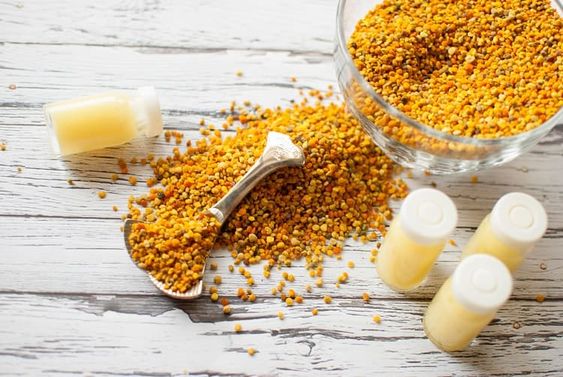
Amount of pollen consumption by bees
The male bees do not feed directly on pollen; Instead, they are fed a mixture of mammary gland secretions, honey, and pollen grains. The queen’s main food is the secretions of the mammary glands, which she nourishes throughout her life. A bee consumes between 120 to 140 mg of pollen during its lifetime. During this period, internal changes occur in the body of the bee. The amount of protein in the body of worker bees during this period reaches 60 to 70% and in males to about 40%.
Pollen grains are important in bee feeding as the only source of protein for larval rearing. Between 1935 and 1942, researchers found that 3.2 milligrams of nitrogen were essential for the growth of a bee. This amount of nitrogen can be obtained from 100 mg of bee bread.
A colony consumes about 20 to 30 kg of pollen annually. It has even been reported to consume 50 kg per year. Pollen collected by pollen traps from one colony can be enough to feed about 50 colonies as a pollen supplement.
Bee bread
Although pollen grains are eaten fresh in bee feeding, But a large number of them are compressed inside the cells with a small amount of honey and secretions and a kind of lactic acid fermentation; This fermented product is called “bee bread”.
Evaluation of pollen protein
In general, the criterion for evaluating pollen protein (quality value) is:
1- Growth of hypopharyngeal glands
2- Amount of pollen consumed (Food consumption)
3- Weight increase
4- Longevity
5- Increasing body fat tissue (Fat body development)
6- Nitrogen excretion by bees
7- Type of Haemolymph spectrum
Nutritional value of different plant pollen for bees
Plant pollen is divided into 4 groups in terms of nutritional value:
1- Pollen grains with very high nutritional value (excellent): such as pollen of fruit trees, burdock, sainfoin, white clover, saffron, and poppy
2- Pollen grains with high nutritional value (good): such as elm, maple, and cotton pollen
3- Pollen grains with medium nutritional value: such as hazelnut, date, and alder pollen
4- Pollen grains with low nutritional value: pollen of coniferous trees such as pine, cypress, spruce
In general, the results of nutritional value tests show that protein and amino acids are the determining basis for the nutritional value of pollen grains.
Effects of pollen deficiency on bee feeding
Lack of pollen in bee feeding causes abnormal complications and abnormal behavior. The most important of which can be mentioned as follows:
Reduction or non-production of royal jelly, reduced lifespan, reduced production of wax and comb, reduced queen spawning rate, insufficient venom production, inadequate ovarian growth, susceptibility to diseases, especially Nosema disease, and lack of ability For wintering.
Biological effects of pollen on bee life
1- Pollen increases the longevity and normal life of bees.
2- It causes ovarian activity and enhancement spawning and population.
3- Pollen in case of deficiency, changes the behavior of bees, including disorders in the production of venom and defensive behavior.
4 – In winter, enough pollen augments the body fat reserves of bees and as a result, the overwintering power increases.
5- Throughout the season, the activity of the hypopharyngeal glands and other glands involved in the production of food for the baby and the queen are directly affected by pollen.
6- The production and secretion of wax by the wax glands are directly related to pollen. Although sugars also play an important role; But pollen has also been shown to play an important role in wax secretion.
7- Pollen in bee feeding causes resistance to some illnesses, especially Nosema disease. In most diseases, an insect that has adequate nutrition and full growth is more resistant.
The amount of pollen needed to feed the bees
Research has indicated that 145 mg of pollen is needed to produce a complete bee. That is, for one gram of pollen, 7 bees are produced. If a colony produces an average of 100,000 bees per year, it will need about 14.5 kg of pollen per year. And to be able to do its other vital tasks such as overwintering, etc., it needs three times this amount, ie about 50 kg of pollen.
If we open a colony door, we have to deal with a pollen-filled frame with about 3 to 4 kg of pollen. And in winter, this amount reaches 3 to 4 pollen frames. In case of lack, this number of colonies is facing problems and a lack of winter food. In this case, this deficiency should be compensated with substitutes such as pollen cake and honeybee feed.
Methods of using pollen in the hive
1- Placing pollen frames in the hives they need, near the place where the babies are raised.
2- Pouring them in shallow plates and placing them on the frames
3- Mixed with syrup
4- In the form of pollen cake
Pollen substitutes
In the absence of pollen in nature, alternative substances should be used. But no substance can completely replace fresh pollen. Therefore, researchers were looking for substances that could replace pollen. For this purpose, some protein substances are mixed with some pollen in bee feeding and used as a supplement. In other words, any protein that is mixed with some pollen is called a supplement.
Pollen surrogate
When there is no pollen to mix with the protein, the protein is used alone; In this case, it is called pollen substitute (no pollen).
In general, supplements are better than pollen surrogates. Because they have some pollen. The types of protein that bees can consume are very different in terms of protein content. (Both quantitatively and qualitatively)
In various sources, protein-containing substances have a protein content of 5 to more than 30% and in some cases even 45% that can be consumed. But high protein content does not mean better quality and reason for preference; In this case, the biological effects should be investigated.
Reviews
Research has indicated that if there is enough pollen, supplement, or pollen surrogate in the form of protein cakes, about 8 weeks before fresh pollen is found in nature in the hive, a large population colony can collect fresh pollen without Pause to develop its population.
If pollen deficiency seasons, ie autumn, winter, and early spring and drought days and lack of suitable vegetation, can be artificially provided to the colony in the form of sweet paste cakes and meet their protein needs, there is no doubt that This activity will have an important effect on having strong and productive colonies.
Obviously, strong and densely populated colonies are less prone to pests and pathogens. And they will easily get past the cold and long winters. Strong populations also play an important role in pollination and ultimately create better efficiencies in the production of honey and other hive products.
Comments