
Sweet paste for bees
Further Details
Sweet paste for bees
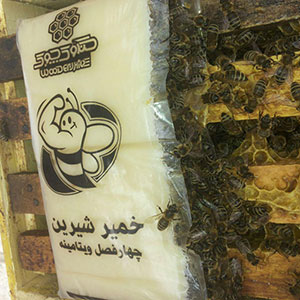
Nutrition is a practice that involves a variety of activities and physiological interactions. As a result of nutrition and gastrointestinal function, substances such as carbohydrates, fats, proteins, etc. are converted into substances needed by the body. Bees, like other energy creatures, get their energy from the food they eat (including sweet paste for bees and pollen cakes).
What is the purpose of bee feeding?
Feeding bee populations during the year is done for different purposes, the most important of which are:
1- Compensating for the lack of honey in the hive
2- Stimulating the queen bee to lay more eggs
3- Preventing the queen bee from laying eggs
4- Providing winter food for bees
1- Compensating for the lack of honey in the hive
This condition occurs when a beekeeper notices honey deficiency in one or more of his hives by opening the hives in the spring or by weighing them in the winter (twice a month). In this situation, populations of such hives should be fed as soon as possible. The choice of food (sweet paste for bees, pollen cake, etc.) that should be given to bees depends on what season of the year it occurs.
A: Between early spring and mid-November
when bees can fly, they are fed with one of the syrups for at least 15 nights and a half to one liter per night.
B: In November, December and January
It is better to leave one or two frames full of honey inside each hive and hang it on a winter cluster. But before hanging inside the hive, the frames should be placed for 24 hours or more in a residential arch that is heated to about 20 degrees, so that the honey is warm and usable for the bees.
C: In February and March
The populations are given sweet paste. In these two months, if the only goal is to supply the lack of honey in the hive, they can be given frames full of honey, and if the decision is to provoke the queen, it is better to use sweet paste.
2- Stimulate the queen bee to lay more eggs with reinforcing nutrition
The amount and method of laying the queen bee, the time of reaching its maximum, its intensity at the beginning and end of laying in each year, are also among the hereditary properties of the queen. All of these properties are inextricably linked to the abundance or scarcity of nectar and pollen in nature. But we can strengthen the queen’s laying hereditary power by artificial feeding (pollen cake and sweet paste for bees) and timely population and force her to start laying as soon as possible. Also, increase the number of eggs it lays each day faster than the day before. So that the population is strong at the end of March and needs a second floor. Such a population in a suitable and flourishing environment will promise a year full of honey to the beekeeper.
The most important stimulating nourishment in February and shortly after the opening of the first pussy flowers or at the same time is done by sweet paste.
3- Preventing reducing queen bees from laying eggs
During the year, it often happens that beekeepers are forced to provide stimulating feeding (using pollen cakes and sweet paste for bees) for some populations, even in the spring. The queen bee should not reduce the number of eggs she lays per day due to the lack of nectar and pollen in nature. The bad thing about this is that whenever the queen bee goes into spawning in a decreasing manner, that is, if the work is moved to the point where the number of eggs she lays each day is less than the day before, it will be very difficult to change the situation and force her again to lay more eggs.
Such a situation usually occurs when the environment is full of bloom and flowers, suddenly empty of any kind of flowers and sources of nectar and pollen. Since it is not possible for us to fight against nature in such a situation, we must pay attention to the demands of the populations and meet their needs as much as possible; To pave the way for them to continue their activities. As a result, the queen always continues to lay eggs as usual and does not reduce her activity.
4- Winter feeding of bees
It would be better to name it (feeding for wintering), which is done for two purposes:
A: Harvest all the honey in the hive and replace it with a syrup prepared with sugar. Because
First, as bees can spend the winter with enough honey, they can also spend the winter with enough sugar and sweet paste.
Second: The price of each kilo of honey in Iran is many times more than sugar. Therefore, it is in the beekeeper’s interest to harvest more honey and instead provide enough sugar to the population in the form of syrup. When the population is small, whether or not their honey is harvested is of little material importance to the beekeeper. But if their number was, for example, 100 or more, it would have a great economic impact on his life.
B: Compensate for the lack of honey in the hives to the extent that the population can spend the fall and winter with it.
Feeding on sweet paste and pollen cake, the bees will have enough reserves even in early spring, until the blossoms of the fruit trees open;
During the autumn visit, the amount of honey left in each hive (after harvesting the last crop) is written on a separate piece of paper. Then, as soon as possible, they compensate for its deficiency with syrup. The best time to give syrups is in the evenings after sunset. Because it will soon be night and there will be no possibility of looting by strong crowds, and crowds usually take out the syrup before morning and when the weather clears.
Contact us to order and buy sweet paste for bees:
+989115602512, +989153004370
Reviews
There are no reviews yet.